
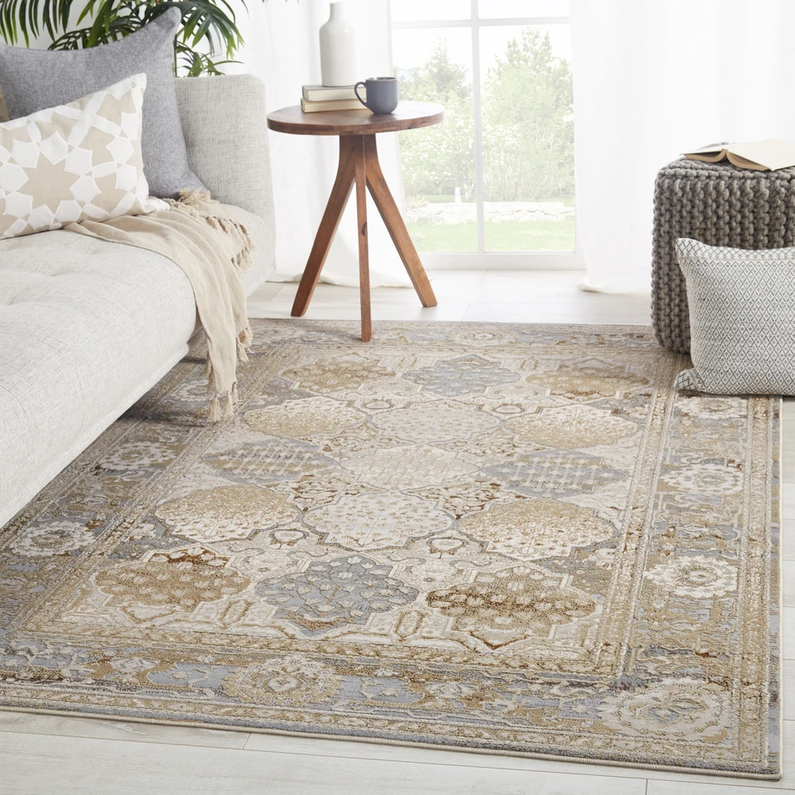
What size rug do I need for my living room?
For most living rooms, an 8' x 10' rug is the right answer. It's large enough that the front legs of your sofa and chairs sit on it, which is what makes a seating area read as one deliberate group instead of furniture scattered on bare floor. Go up to a 9' x 12' if your room is larger than about 13 by 16 feet or open to a dining area, and down to a 5' x 8' only in a small apartment living room where anything bigger would run wall to wall.
That covers most people. If your room isn't most rooms, here's how to work it out properly.
Start with the furniture, not the room
The most common sizing mistake is measuring the room and buying a rug that fits it. A rug isn't wall-to-wall carpet — its job is to define the seating area, and the seating area is almost always smaller than the room.
Measure the footprint of your seating group instead: the outer edges of the sofa, chairs, and anything else that belongs to the conversation. Your rug should be at least as wide as that footprint, ideally 6 to 8 inches wider on each side.
Then check it against the room. You want roughly 12 to 18 inches of bare floor showing between the rug edge and the walls. Less than that and the rug looks like carpet that was cut wrong. Much more and the seating group starts to float.
The three placement rules
All legs on. Every piece of furniture sits fully on the rug. This is the most generous look and the most expensive — it usually means a 9' x 12' or larger. Worth it in big rooms, where a smaller rug just looks lost.
Front legs on. The front legs of the sofa and chairs rest on the rug, the back legs are on the floor. This is the workhorse arrangement and what an 8' x 10' is built for. It anchors the group without demanding a rug the size of the room.
Floating. Only the coffee table sits on the rug; all seating is off it. This works in small rooms and reading nooks, and it's the right call for a 5' x 8'. It's the weakest of the three visually, so use it when the alternative is a rug that doesn't fit.
Pick a rule before you pick a size. The rule determines the size, not the other way around.
Sectionals are a different problem
Measure the full footprint including the chaise, then add at least 12 inches on the open sides. Most sectionals need a 9' x 12'. An 8' x 10' works for a compact two-piece.
The mistake to avoid: a rug that stops short of the chaise. It splits the sectional visually and makes the whole arrangement look accidental. If you have to choose between a rug that's slightly too big and one that stops short of the chaise, take the bigger one.
Nominal size and actual size aren't the same
Rugs are sold by nominal size, and the finished piece is usually a little under. An 8' x 10' commonly measures around 7'10" x 9'10". A few inches rarely matters, but it does when you're threading a rug between a fireplace hearth and a doorway.
Every product page lists exact finished dimensions. If your placement is tight, read those rather than the size on the label.
Test it before you buy
Painter's tape on the floor, in the exact rug dimensions. Leave it up for a day and walk through the room a few times.
You'll catch things a tape measure won't: a rug edge landing where a door swings, a traffic path that clips a corner, a coffee table that suddenly looks undersized. Ten minutes here saves a return.
Quick reference
- 5' x 8' — apartment living rooms, reading nooks, floating arrangements under a coffee table
- 8' x 10' — the standard living room, front-legs-on with a sofa and two chairs
- 9' x 12' — large or open-plan rooms, sectionals, all-legs-on arrangements
- 12' x 15' — great rooms and open-plan spaces where a 9' x 12' leaves too much bare floor
- Round, 6' to 8' — round or square seating areas, and rooms with a lot of hard corners
One more thing: get a rug pad
A pad keeps the rug from sliding, adds cushion underfoot, and — the part people don't think about — absorbs the abrasion that would otherwise grind down the rug's backing against a hard floor. It's the cheapest thing you can do to make a rug last.
Felt-and-rubber on hardwood and tile. A thinner grip pad if the rug is going over carpet.
Shop the sizes
Browse our full area rug collection, filterable by size, shape, color, material, and construction. We carry Nourison, Loloi, Capel, and Feizy, among others — and you'll find rug pads in the same department.
Recent Posts
-
What size rug do I need for my living room?
For most living rooms, an 8' x 10' rug is the right answer. It's large enough that the front legs of …Aug 25th 2026 -
Curved Mid‑Century Wire Mesh Outdoor Seating Inspired by Celebrity Style
Outdoor living has evolved from basic backyard setups to curated, style-driven environments that mir …Jul 30th 2025 -
Why Mango Wood Kitchen Accessories Are a Must Have
In today’s design-savvy world, homeowners are more conscious than ever about the style and sustainab …Jul 29th 2025